

Health and Productivity Management
Health Declaration
The Press Kogyo Group believes that physical and mental health is the most important thing in order for our employees to demonstrate their abilities to the fullest and for both individuals and the company to grow steadily step by step. In order to promote healthy management as an important management issue, we established the following "Press Kogyo Group Health Declaration".
Health Declaration
The Press Kogyo Group believes that each and every employee, who is an important asset, should take an interest in their health and work energetically both physically and mentally, which will lead to the happiness and vitality of our employees and their families.
In order for our employees and our group to grow together in the future, we will actively support health promotion, work to create a vibrant work environment, and contribute to the development of society.
April 1, 2024
PRESS KOGYO CO.,LTD.
President & COO
Yuki Shimizu
Certification as a 2026 Certified Health & Productivity Management Organization
We have been recognized as a 2026 Certified Health & Productivity Management Organization (Large Enterprise Category).
The Certified Health & Productivity Management Organization Recognition Program is a system that commends companies demonstrating excellence in health and productivity management through initiatives addressing local health issues and health promotion efforts led by the Japan Health Council.
Under the “Press Kogyo Group Health Declaration,” we will continue working to enhance workplace environments and health support in cooperation with our health insurance society, so that our employees can remain physically and mentally healthy and work with vitality.
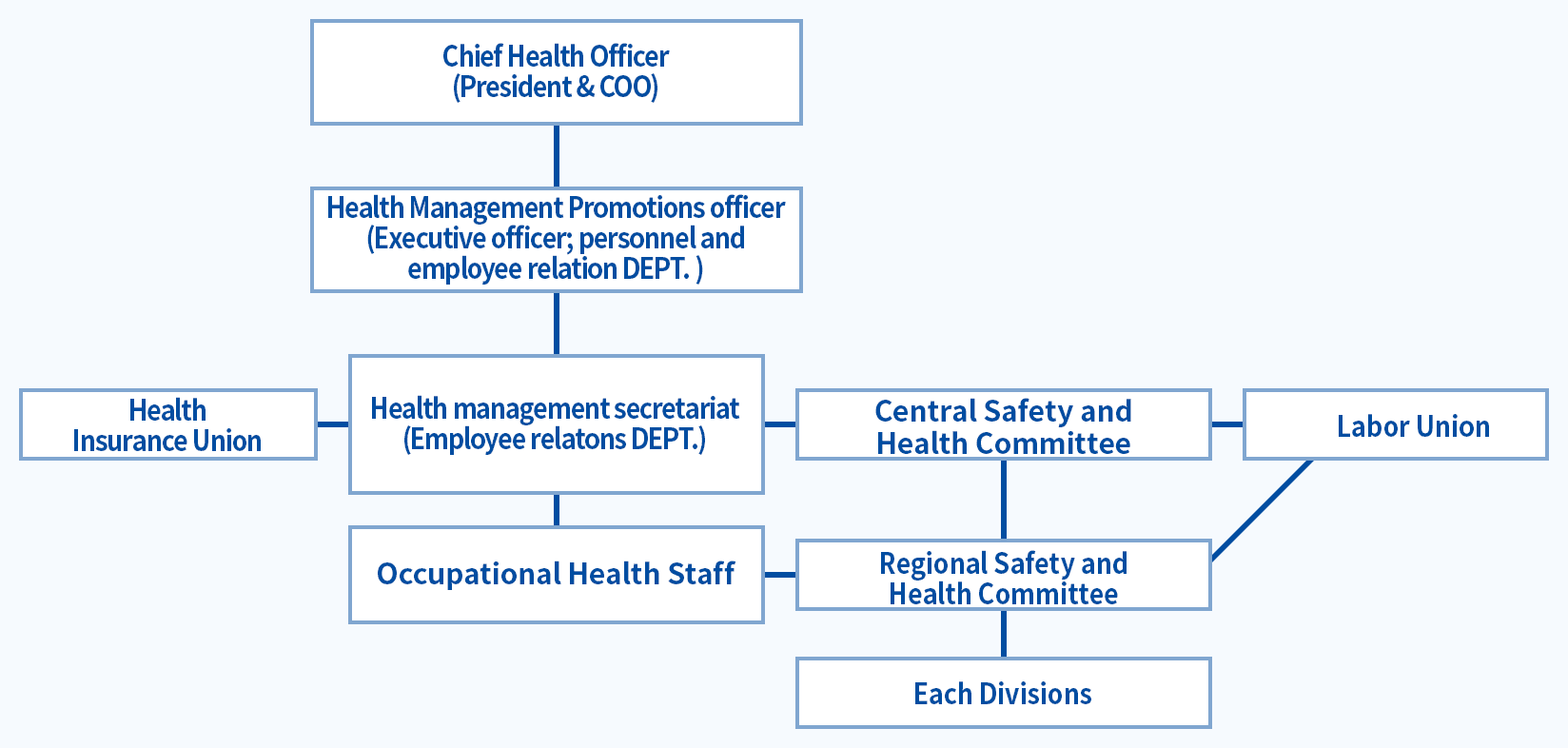
Our health management system
We placed a health promotion officer under Chief Health Officer, and the employee relations DEPT. under him serves as the secretariat for the entire company. We will integrate various health measures into the policies and activities of the central and regional safety and health committees, and promote various measures in cooperation with health insurance associations and labor unions.
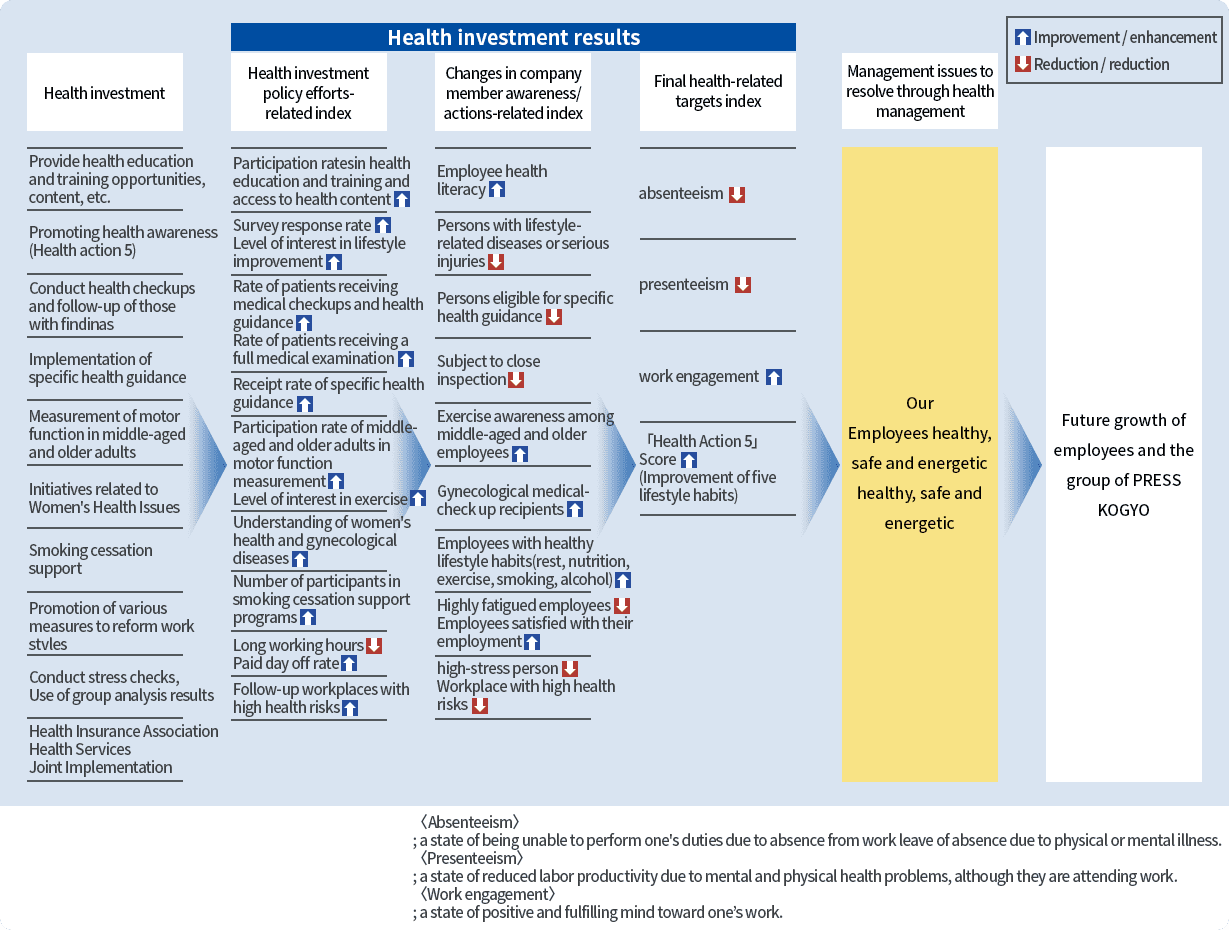
Health Management Strategy Map
We promote measures based on a "Health Management Strategy Map" that clarifies the relationship between management issues and specific measures that we want to solve through health management.
Health Management Strategy Map
Health action 5
Health action 5
In order to maintain and improve mental and physical health, it is important for each employee to be aware of and acquire healthy lifestyle habits.
For this reason, by focusing on the "5 items of lifestyle habits" and regularly checking them, they should be interested in their own health, and they should "quantify" the health level of the organization and work on it as a priority. We will try to understand the issues.
| Targets | Questions | Choices | FY2023 Results | |
|---|---|---|---|---|
| Rest | No sleepiness or fatigue throughout the week | Do you feel sleepy or fatigued during the day (including night shifts)? | No sleepiness or fatigue throughout the week | 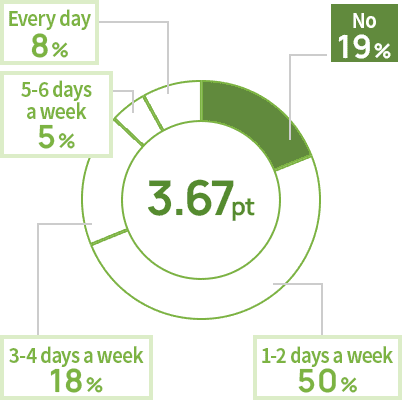 |
| Feel sleepy and lethargic 1-2 days a week | ||||
| Feel sleepy and lethargic 3-4 days a week | ||||
| Feel sleepy and lethargic 5-6 days a week | ||||
| Feel sleepy and lethargic everyday | ||||
| Nutrition | Have breakfast every day | Do you eat breakfast? | Eat every day | 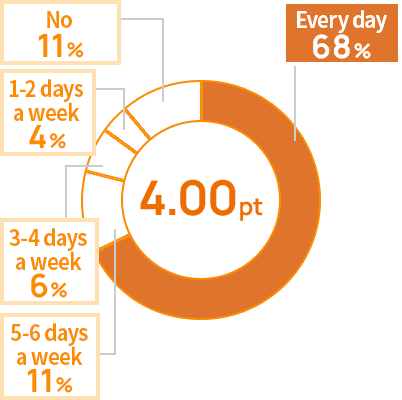 |
| Eat 5-6 days a week | ||||
| Eat 3-4 days a week | ||||
| Eat 1-2 days a week | ||||
| Do not eat | ||||
| Exercise | Exercise for more than 30 minutes twice a week for over a year | Do you exercise for at least 30 minutes at a time, to the point of sweating? | Exercise at least twice a week /for 1 year | 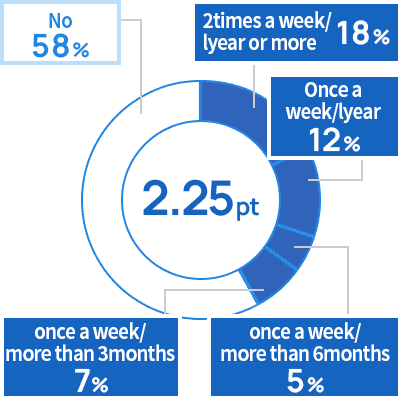 |
| Exercise at least once a week /for 1 year | ||||
| Exercise at least once a week /for 6 months | ||||
| Exercise at least once a week /for 3 months | ||||
| Do not exercise | ||||
| Smoking | Don't smoke, or cut down | Do you smoke (including heated and electronic types)? | Do not smoke | 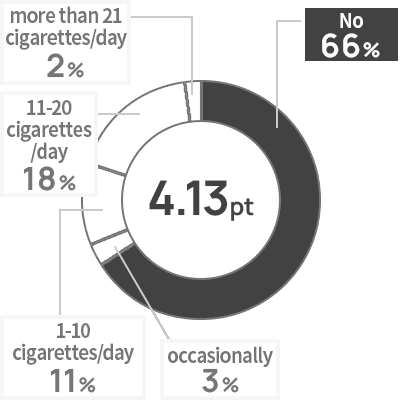 |
| Don't have a habit, but I smoke occasionally | ||||
| Smoke 1-10 cigarettes/day | ||||
| Smoke 11-20 cigarettes/day | ||||
| Smoke more than 21 cigarettes/day | ||||
| Alcohol | Don't drink, or reduce | Is your alcohol consumption moderate? (20g of pure alcohol per day) | Do not drink, or drink less than a moderate amount | 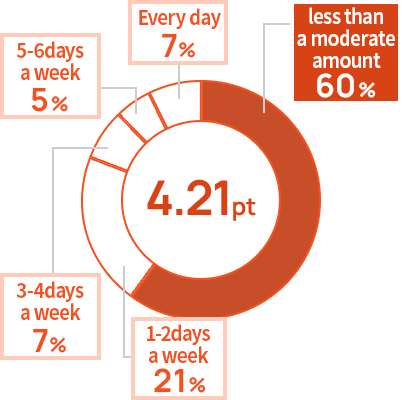 |
| Exceed the appropriate amount 1-2 days a week | ||||
| 3-4 days a week, exceeding the appropriate amount | ||||
| 5-6 days a week, exceeding the appropriate amount | ||||
| Exceed the proper amount every day |
Survey results and goals
| Initiatives | FY2022 | FY2023 | FY2024 | |
|---|---|---|---|---|
| Overall Evaluation Index | 3.68pt | 3.69pt | 3.71pt | |
| Rest | Adequate sleep habits | 21.0% | 19.2% | 20.6% |
| Nutrition | Breakfast eating habits | 67.6% | 68.1% | 70.0% |
| Exercise | Moderate exercise habits | 39.5% | 41.5% | 43.0% |
| Smoking | non-smoking | 65.6% | 66.3% | 66.6% |
| Alcohol | Moderate(20g≧day) drinking habits | 58.7% | 59.9% | 59.0% |

| FY2028Target Value |
|---|
| 3.93pt |
| 20.2% |
| 71.5% |
| 43.6% |
| 69.6% |
| 62.9% |
Health Goals
Absenteeism
Annual number of absenteeism/leave days due to injury or illness
| Initiatives | FY2020 | FY2021 | FY2022 | FY2023 | FY2024 |
|---|---|---|---|---|---|
| Number of days absent from work per employee/year | 2.08days | 2.35days | 2.58days | 2.29days | 2.18days |
| Total number of days absent due to injury or illness | 3751days | 4101days | 4742days | 4134days | 3826days |
| Average enrollment | 1804 | 1747 | 1835 | 1804 | 1756 |
| FY2028 Target Value |
|---|
| Less than 2.58days |
| ー |
| ー |
Performance
Presenteeism:Percentage decline in labor productivity (Single-Item Presenteeism Question (SPQ) developed by the University of Tokyo)
| Initiatives | FY2020 | FY2021 | FY2022 | FY2023 | FY2024 |
|---|---|---|---|---|---|
| Performance (%) | ー | ー | ー | 79.7% | 78.6% |
| Number of respondents | ー | ー | ー | 1769 | 1674 |
| Response rate (%) | ー | ー | ー | 100% | 94.8% |
| FY2028 Target Value |
|---|
| 82.5% |
| ー |
| ー |
「Performance」=100%-Presenteeism (rate of lost productivity)
Work Engagement(From the Work Engagement Survey Results)
Individual activity rate(Measured by the New Brief Job Stress Questionnaire(80 questions))
| Initiatives | FY2020 | FY2021 | FY2022 | FY2023 | FY2024 |
|---|---|---|---|---|---|
| Work engagement (max=4.0) |
2.23 | 2.25 | 2.26 | 2.25 | 2.33 |
| Number of respondents | ー | ー | ー | 1717 | 1785 |
| Response rate (%) | ー | ー | ー | 100% | 98.7% |
| FY2028 Target Value |
|---|
| 2.3 or more |
| ー |
| ー |
~The Relationship Between Employees' Lifestyles and Work Productivity~
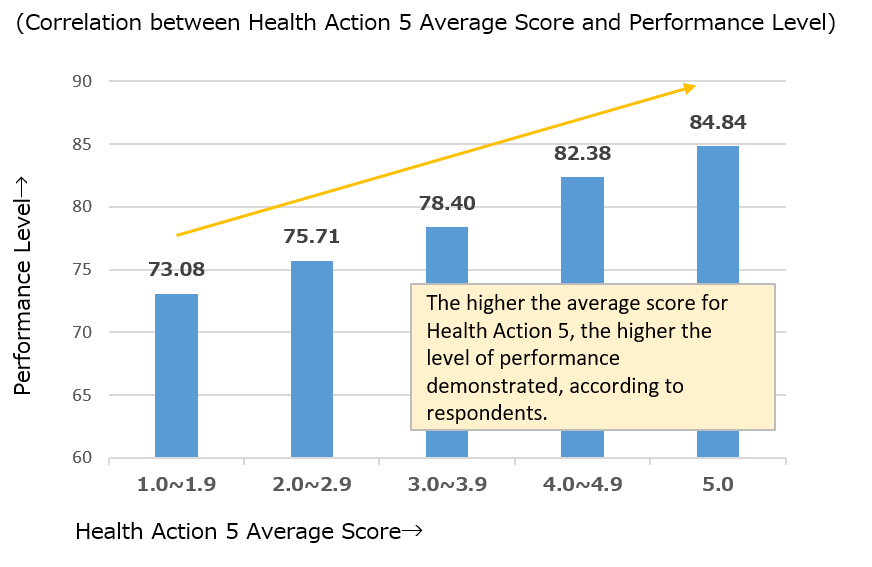
We divided the average scores of the five items of Health Action 5 into five levels from 1 to 5 and analyzed the performance levels of each group. The results showed that people with higher average scores on Health Action 5 reported higher performance levels. From this, it can be expected that working on improving lifestyle habits may lead to enhanced work performance.
Our company has established “improved performance levels (reduction in presenteeism)” and “reduction in absenteeism”—both indicators of labor productivity—as our ultimate health-related target metrics. Furthermore, we believe that “enhancing work engagement” improves employees' health management awareness and contributes to sustaining high performance over the long term. We will regularly measure and evaluate these as health target metrics and use the results to implement necessary measures.
Main initiatives
Cultivating Good Physical Health
1.Health Checkups
In addition to the legally mandated medical checkup items, we provide a wide range of health checkups for our employees, including cancer screening. In addition to regular subsidies for physical examinations, the health insurance association also provides an opportunity for "milestone checkups" for 40 - and 55-year-olds and their spouses , who wish to undergo physical examinations, all costs subsidized, encourage them to take the examinations. After the checkups are conducted, those with findings or those who require close examination are followed up at the company's clinic. Follow-up is provided for those who are found to be in need of medical checkups and those who are in need of close examination.
Rate of regular medical checkups
| Initiatives | FY2020 | FY2021 | FY2022 | FY2023 | FY2024 |
|---|---|---|---|---|---|
| Rate of regular medical checkups | 95.3% | 100% | 100% | 100% | 99.9% |
| FY2028 Target Value |
|---|
| 100% |
Percentage of abnormal findings in regular medical checkups
| Initiatives | FY2020 | FY2021 | FY2022 | FY2023 | FY2024 |
|---|---|---|---|---|---|
| Rate of findings | 59.0% | 51.9% | 53.1% | 52.9% | 53.0% |
Rate of detailed examination based on the results of regular medical checkups
| Initiatives | FY2020 | FY2021 | FY2022 | FY2023 | FY2024 |
|---|---|---|---|---|---|
| Rate of detailed examination based on the results of regular medical checkups | ー | 61.4% | 67.7% | 73.4% | 72.4% |
| FY2028 Target Value |
|---|
| 80.0% |
Health status of employees (percentage of non-risk personnel)
Eligibility : 30 years old and over
| Initiatives | FY2020 | FY2021 | FY2022 | FY2023 | FY2024 |
|---|---|---|---|---|---|
| Appropriate weight (18.5≦BMI<25) |
66.8% | 65.7% | 64.6% | 64.5% | 62.6% |
| Blood pressure (normal) | 70.4% | 82.7% | 78.9% | 79.4% | 79.9% |
| Lipids (normal) | 59.0% | 60.5% | 63.1% | 67.5% | 64.6% |
| Blood sugar (normal) | 79.3% | 87.2% | 87.2% | 85.9% | 86.1% |
| All the three items(normal) (three items:BP, Lipid and BS) | 40.1% | 46.4% | 46.3% | 48.8% | 46.6% |
Specific health guidance
We conduct specific health guidance primarily at our in-house clinics under commission from the health insurance association. We also place emphasis on implementing “preemptive specific health guidance” for individuals under 40 who may become future guidance targets.
| Initiatives | FY2020 | FY2021 | FY2022 | FY2023 | FY2024 |
|---|---|---|---|---|---|
| Rate of specific health guidance implemented※ | ー | 66.1% | 76.8% | 59.5% | ー |
| FY2028 Target Value |
|---|
| 80% |
Rate of specific health guidance implemented:Percentage of final interview completers
2.Sleep Improvement
Analysis of the relationship between each item in Health Action 5 and performance levels revealed a strong correlation between “Rest (Sleep)” and work performance. Consequently, we implemented e-learning on sleep for all employees. Additionally, for employees facing particular sleep challenges, we conducted individual sleep status checks and provided reports detailing their results and personalized advice. (98 employees targeted; 68 responded) Furthermore, to deepen understanding of the report content and drive behavioral change, individual counseling sessions conducted by occupational health staff are being implemented to motivate employees toward securing quality sleep.

Personal Sleep Report MySleep
(Neurospace Inc.)

Conduct individual counseling sessions by occupational health staff
3.Motor function measurement for middle-aged and elderly employees
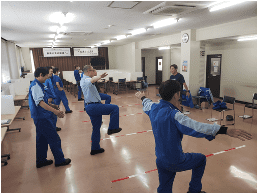
Three types of motor function measurements (Stride length test, standing up on one leg, standing on one leg with eyes closed) are carried out for middle-aged and older employees.
By recognizing the gap between the image of one's own motor function and the actual motor function, it promotes awareness of exercise habits, which leads to improvement of healthy age and prevention of occupational accidents due to falls.
※1.The proportion of those whose results were above average in all three test items.※2.The number of people who responded “already working on it” or “want to improve exercise habits” in the survey.
| Initiatives | FY2020 | FY2021 | FY2022 | FY2023 | FY2024 |
|---|---|---|---|---|---|
| Number | ー | ー | 223 Persons | 192 Persons | 186 Persons |
| participation rate | ー | ー | 81.2% | 76.0% | 86.5% |
| Average or above average※1 | ー | ー | 32.6% | 42.5% | 40.3% |
| The proportion of people with an improvement mindset※2 | ー | ー | 63.7% | 62.0% | 61.9% |
4.Smoking Measures
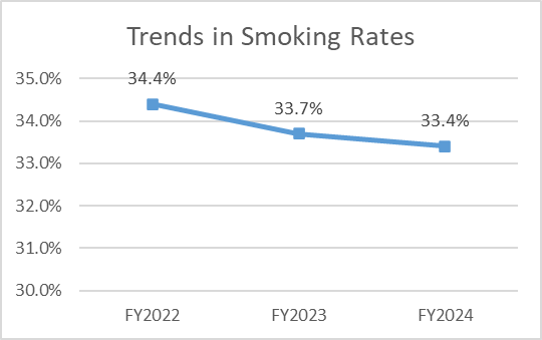
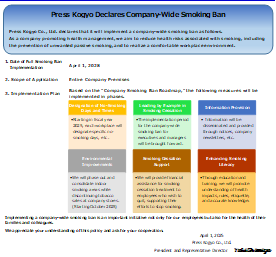
The smoking rate among employees has been gradually declining each year, yet it remains significantly higher than the national average of 15.7% (*). To reduce health risks and strengthen measures against secondhand smoke, we have created a roadmap for implementing a company-wide smoking ban starting April 2028. In April 2025, the President issued a “Company-Wide Smoking Ban Declaration” to kick off the initiative. We are advancing activities based on four pillars: awareness raising, environmental improvements, smoking cessation support, and enhancing smoking literacy.
※ National Health and Nutrition Survey, 2023
Main initiatives
Cultivating Good Mental Health
1.Stress check
We conduct Stress Check once a year, using "The New Brief Job Stress Questionnaire(80 questions)". Not only domestic employees, but also employees seconded to overseas affiliated companies are included. For those who are determined to have high levels of stress, a meeting with a counselor is set up to provide individual aftercare, and based on the results of group analysis, a meeting with the head of the department is also held.
Rate of stress check attendance
| Initiatives | FY2020 | FY2021 | FY2022 | FY2023 | FY2024 |
|---|---|---|---|---|---|
| Rate of stress check attendance※ | 99.1% | 99.7% | 99.5% | 99.4% | 99.9% |
| FY2028 Target Value |
|---|
| 99.5% or more |
Examination rate:Response rate
Percentage of people with high stress
| Initiatives | FY2020 | FY2021 | FY2022 | FY2023 | FY2024 |
|---|---|---|---|---|---|
| Percentage of company members with high stress | 12.3% | 14.4% | 13.3% | 13.8% | 14.0% |
| FY2028 Target Value |
|---|
| 12.4% |
Workplace health risk situation
| Initiatives | FY2020 | FY2021 | FY2022 | FY2023 | FY2024 |
|---|---|---|---|---|---|
| Workplace health risk average | 99 | 102 | 103 | 100 | 98 |
| Proportion of high-risk workplaces for health※1 | 19.4% | 21.3% | 25.2% | 19.6% | 15.2% |
※1.The overall health risk exceeds 120
Groups with fewer than 5 valid responses are excluded from evaluation.
Criteria for setting group analysis targets to be changed from fiscal year 2023
1. Stress Check Implementation
We conduct annual stress checks using "The New Occupational Stress Simplified Questionnaire (80 questions)". This includes not only domestic employees but also those on assignment at overseas affiliated companies.
For those assessed as having high stress levels, counseling sessions are provided. Medical consultations are arranged for those who request them. Furthermore, based on group analysis results, opportunities for discussions with counselors are arranged primarily for managers of workplaces identified as having high health risks. This supports deeper understanding of the results and provides advice to improve workplace conditions.
2. Harassment Prevention
To prevent power harassment in the workplace, we implemented e-learning training for all employees. Participants viewed multiple case studies, including instances of harassment not only from superiors but also from subordinates, to foster a shared understanding.
Other initiatives
1.Status of Internal Training
As part of National Occupational Health Week and Preparation Month activities, we hold health-related training sessions annually with a changing theme. In fiscal year 2024, we conducted a “Training on Interpreting and Utilizing Stress Check Results” for managerial and supervisory staff, with 152 participants. (total eligible participants: 156, including recorded viewers) Additionally, we conduct training to improve health literacy through opportunities such as new employee orientation, promotion training, and tiered education programs.
2.For women's health issues
Implementation of Gynecological Screenings
In collaboration with the health insurance association, mobile gynecological screenings (for breast cancer and cervical cancer) are conducted at some workplaces. For workplaces where mobile screenings are difficult to arrange, or for individuals preferring to receive care at medical institutions, opportunities are provided through comprehensive health checkups or optional gynecological screenings.
Promoting Understanding of Women's Health Issues
We conducted e-learning training for managers to deepen their understanding of women's health issues.
Additionally, we held training sessions for female employees to enhance their knowledge of gynecological diseases and recognize the value of screenings.
This was our first training session exclusively for female employees. 145 female employees participated (92% participation rate), indicating high interest. Participants provided many positive responses, such as “I understood the importance of medical examinations and tests” and “My concerns about the HPV vaccine were alleviated.”
- PRESS KOGYO TOP
- Sustainability
- Society
- Health and Productivity Management