
Addressing Climate Change
Approach to the Climate Change Issue
As a key player in the automotive parts industry, we have long supported social development. However, the global scale of climate change poses significant challenges to our operations and society at large. Thus, our commitment to addressing this critical issue is crucial for ensuring the sustainability of our business. Our efforts towards achieving carbon neutrality are a vital part of this commitment.
Towards Carbon Neutrality
To reduce CO₂ emissions, we have worked to systematically implement reduction measures accumulated across the Group, such as promoting energy-saving activities at our production sites, improving the energy efficiency of production equipment, and switching to renewable energy-derived electricity and other sources.
Although we made progress in reducing Scope 1 and 2 CO₂ emissions, rising demand increased production activity, leading to higher energy consumption and CO₂ emissions. Consequently, our FY2025 target was not achieved. In addition, in FY2025, we revised our calculation method for Scope 3 emissions to further improve the comprehensiveness of the activity data covered in the calculation scope and achieve more precise calculations that better reflect actual conditions. As a result, Scope 3 emissions increased by 21.4% compared to the base year.
Going forward, we will continue to consider reduction measures, such as unifying emission unit data into a single system. To achieve our 2030 target, we will further accelerate each initiative, strengthen energy-saving measures such as visualizing energy consumption, and strive to enhance production efficiency, steadily working towards achieving carbon neutrality across the Group by 2050.

Scope1・2 down 41% in 2030

Scope3 down 20% in 2030
| Metrics | Scope | Base Year | Emissions in Base Year | Target Year | Target |
|---|---|---|---|---|---|
| CO2 emissions | Scope1・2(Consolidated) | FY2019 | 110,000 t-CO2 |
FY2025 | 86,900 t-CO2, down 21% compared to FY2019 |
| FY2030 | 64,900 t-CO2, down 41% compared to FY2019 | ||||
| FY2050 | Net zero emissions | ||||
| Scope3(Consolidated) | 1,134,072 t-CO2 |
FY2030 | 907,200 t-CO2, down 20% compared to FY2019(based on C1,3,5) | ||
| FY2050 | Net zero emissions |
Endorsement of TCFD Recommendation
We endorse the TCFD recommendations and discloses information related to climate change according to the recommendations.

Informtion Disclosures Based on TCFD Recommendation
Governance
The Press Kogyo Group has positioned the climate change issue as one of the important management challenges and works positively and proactively based on the Environment Policy under the supervision of the Board of Directors.
The Central Committee on Environment (held four times a year), which is led by the officers in charge of the Manufacturing Department and the Human Resources, manages and responds to environmental issues overall, including climate change and strongly promotes CO₂ emission reduction (target setting, measures and implementation).
The Central Committee on Environment reports details of its activities to the Management Meeting and important items are discussed and determined at the Management Meeting and the Board of Directors as needed.

Strategy
Following the TCFD recommendations and its framework, the Group performs scenario analyses of risks and opportunities in order to evaluate the level of impact of climate change on the Group's business activities. When performing these analyses, the Group considers a set of climate-related scenarios (4℃ scenario, 2℃ or lower scenario, etc.) of the IPCC (Intergovernmental Panel on Climate Change).
The actions against risks/opportunities are determined considering current/future issues and viewpoint of new-value creation of the Group.
The details and evaluation results of the scenario analyses are given below.


Risk Management
The Group advances our risk management activities under the leadership of the Representative Director and President, who holds the highest responsibility for risk management, in accordance with our Risk Management Basic Policy and Risk Management Regulations. Additionally, the Group has established the Risk Management Committee (Chairperson: Representative Director, Committee members: Executive officers at the level of executive managing officer or higher, Frequency: Once per quarter) and assesses the materiality of risks identified by each division and affiliate, decides on response policies, and manages the progress of addressing these risks.
The climate change-related risks are also identified as the important risk of the Group and are to be managed in the risk assessment & management process given above.

Metrics and Targets
The Company has set emission reduction targets as follows for the short term, medium term and long term.
To achieve each reduction targets towards realization of carbon neutrality, the Group proceeds various measures including introduction of highly efficient facilities, revision of production processes, increase of productivity, new technology, streamlining operations, and the utilization of green energy such as photovoltaic power generation system based on the perspectives of "quit, fix, stop, reduce, reuse, and change".
Initiative for Carbon Neutrality
The Company has set emission reduction targets as follows for the short term, medium term and long term. To achieve each reduction targets towards realization of carbon neutrality, the Group proceeds various measures including introduction of highly efficient facilities, revision of production processes, increase of productivity, new technology, streamlining operations, and the utilization of green energy such as photovoltaic power generation system based on the six perspectives of “quit, fix, stop, reduce, reuse, and change”.
| Six Perspectives | Initiatives under Scope1 | Initiatives under Scope2 |
|---|---|---|
| Change |
|
|
| Reduce |
|
|
| Reuse |
|
ー |
| Quit |
|
|
| Fix | ー |
|
| Stop | ー |
|
Major Initiatives in FY2025
Transition to Renewable Energy
As part of our efforts to reduce CO₂ emissions, in FY2025, we promoted a transition to electricity derived from renewable sources by installing solar panels at the Fujisawa Plant and our locations in Thailand. Also, at one of our Thai locations (THAI SUMMIT PK CORPORATION Ltd.), we started operating solar panels under a power purchase agreement. As a result, the effect of installing solar panels on reducing CO₂ emissions is approximately 145t-CO₂/year on the non-consolidated basis and a total of 1,720t-CO₂/year at our locations in Thailand.

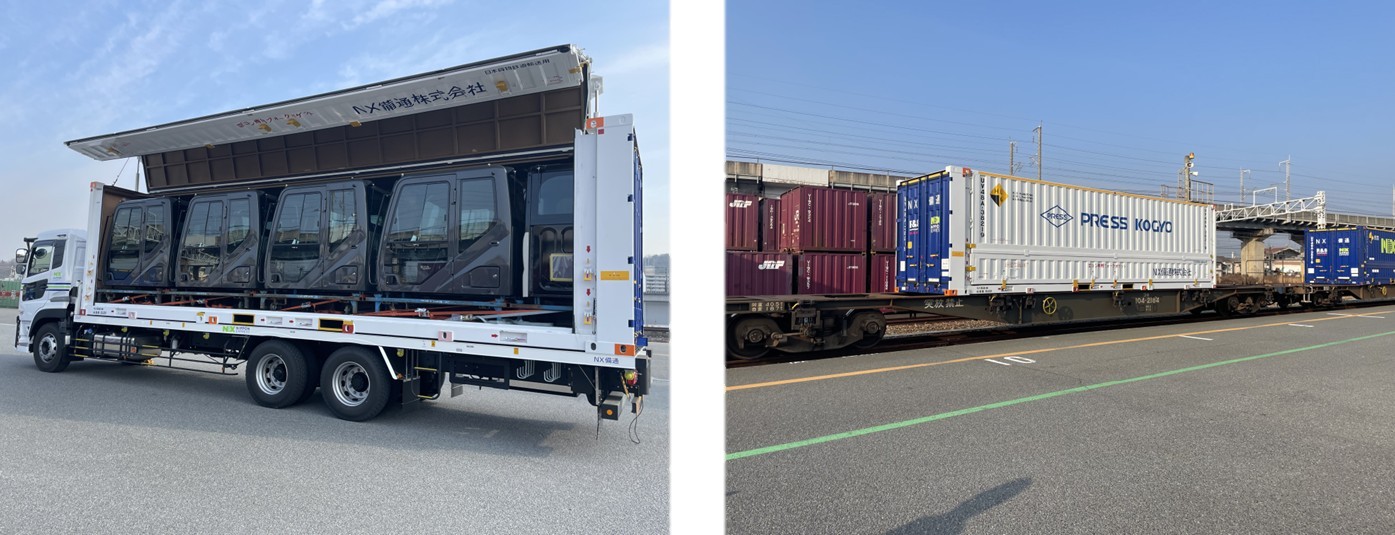
Initiatives Advancing a Modal Shift
We have implemented a modal shift at the Onomichi Plant by switching from trucks to rail, which has less of an environmental impact, when delivering finished products to customers in the Kanto region. As a result, we reduced annual CO₂ emissions by about 65 tonnes in FY2025
External Evaluation: CDP
CDP is an international non-profit organization that supports companies and public authorities in disclosing their environmental efforts, including climate change initiatives, greenhouse gas (GHG) emissions reduction, water security, and forest conservation measures. In the 2024 CDP Climate Change assessment, we achieved a score of B, which corresponds to the Management level.
We will continue to enhance our environmental initiatives and contribute to the realization of a sustainable society.

| Climate change | Water security |
|---|---|
| B | C |
- PRESS KOGYO TOP
- Sustainability
- Environment
- Addressing Climate Change